College vs. Construction Careers? The Answer May Surprise You
|
Construction careers offer more pathways than many people realize. Whether someone starts in college, through an internship, or on a jobsite, there are multiple ways to build a successful future in the construction industry.
Brooks Bass, a recent graduate of a construction management master’s program, started his college education not in any construction program at all. It wasn’t until after finishing his undergraduate degree in journalism and marketing that someone close to him suggested pursuing a degree in construction.
“I was probably one of the few, if not the only one, in my program that didn’t have an internship or a previous construction background.” said Bass. “With how instant terms and words were thrown at me, I was like ‘I gotta learn to keep up.’”
And, after six months into his program, Bass got a job at Big-D Companies on the marketing team.
“A master’s degree is like an endurance race—it’s a firehose of information,” he said. “What made it valuable for me was being able to apply those lessons at Big-D. Working on the marketing team gave me the chance to connect with every department and see how the concepts I was learning worked in practice.”
Brooks path intro construction began at a university classroom. For Brian Johnson, General Superintendent for Big-D, his path started decades earlier by simply showing up for work.
“I interviewed with Big-D in 1989 and was hired as an apprentice. I worked at the Smith’s warehouse in Layton and knew that this was my opportunity,” said Johnson.
Johnson’s opportunity was not to climb through the construction ranks to general superintendent. Johnson’s opportunity was to be outside, learn new things, and earn a steady paycheck. The advancements and promotions through his career were not his main goal, they simply happened because Johnson showed up and performed each working day.
“I could have been a journeyman. I felt good going home at night after a day’s work,” said Johnson. “In my mind, things were given to me because I showed up and did my job. And when I was asked to be a general superintendent, I was ready because I knew the technical side and the construction side of the business.”
Although Johnson didn’t get a construction degree in college, he believes college can provide an important foundation for a career in construction, but he also sees value in learning the industry firsthand. For him, working in the field is where one begins to understand the people, the work, and the culture are worth building a career with.
“I am more passionate about people that put on their tools and go into the industry,” said Johnson. “I think they learn to love the company harder when they put their blood, sweat, and tears in it because they have gone through the ranks and they have to earn it before you get compensated.”
While Johnson’s career began in the field nearly four decades ago by simply showing up for work, for many entering the industry today, that first opportunity begins through an internship.
For Jaime Torres, a recent Big-D intern who is now a full-time employee, the internship experience differed from the role he was ultimately hired to fill, but it still provided valuable perspective as he transitioned into his new position.
“I got an internship in estimating. I was mostly in an office. Very different dynamic but I got to see a lot of the pre-con, takeoff, and the numbers behind each project and it made me see construction in a different way,” said Torres.
 Jaime Torres, Big-D Midwest
Torres is now working full time as a project engineer for Big-D Construction Midwest and balances his time both in the office and out on his very first project in his new role. A project that he just so happened to do an estimate on during his internship.
With employment in construction and extraction expected to grow “faster than the average for all occupations from 2024 to 2034” according to the U.S. Bureau of Labor Statistics, the Big-D internship program is giving hope for the next generation of workers as they prepare to enter the workforce.
Dylan Wood, Kyle Tomimbang and Malia Bulloch are current students at Arizona State University and are project engineer interns at the Big-D Southwest office. Though not acquainted with each other on campus, the internship has brought them together and given them a space to talk and support each other.
“The current job market is very competitive…We are very blessed the way we can network. Our professors share their contacts and take us to work events to meet people,” said Bulloch.
“It’s [construction] comparable to nursing. You’re always going to need more,” said Tomimbang.
Their peers often assume construction work is limited to physical labor in the field, while their internships include estimating, paperwork, coordination, technology, and project management.
“My friends only see the side of pouring concrete, twisting rebar and when I show them a picture of me in the office, they are so surprised,” said Wood. “They just don’t see the millions of dollars and work behind each project. They just see something getting built.”
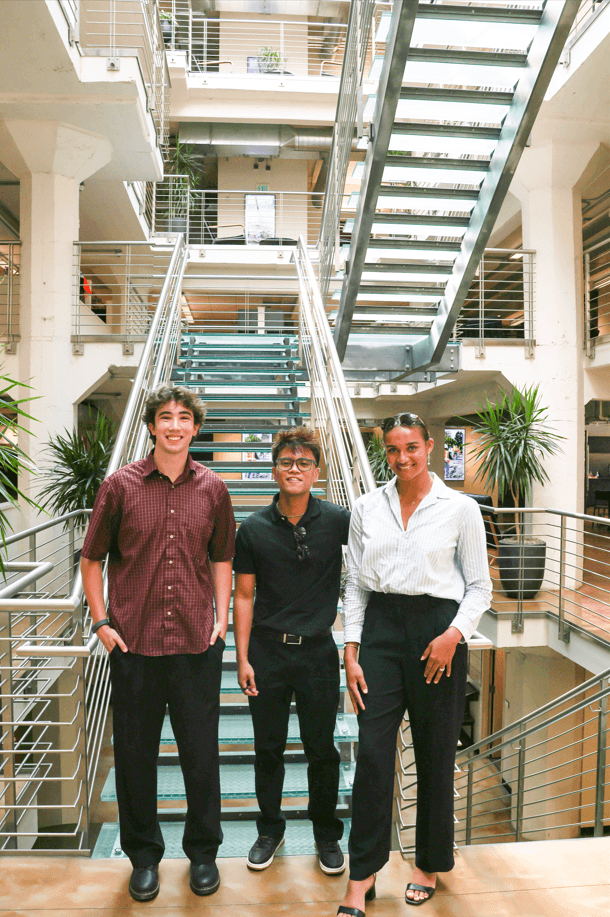 Southwest interns visiting the Big-D Salt Lake Office. Left to right: Dylan Wood, Kyle Tomimbang, and Malia Bulloch.
All three interns explained how often they find themselves breaking down common myths about careers in construction. For Bulloch, some of the biggest misconceptions extend beyond construction itself and reflect lingering assumptions about women working in the field.
“One moment that stands out to me was when we were golfing and we were all sharing our careers and my husband shared that he’s a biomedical engineer and I shared I’m studying to be a construction manager and everyone said 'Oh, it’s a good thing you married your husband',” said Bulloch. “There’s a lot of assumption that I am not going to make any money.”
These students are not only learning the work; they are also confronting an image of construction that has not kept pace with the industry itself.
With more than 20 interns across Big-D Companies this year, including participants from McAlvain Construction and Martin-Harris Construction, the internship program provides students with hands-on experience that goes far beyond the classroom.
Big-D Construction Southwest interns credit Big-D with helping them develop skills they never expected to learn. Throughout the summer, they have communicated with project stakeholders, contributed to project plans, and worked alongside superintendents and project managers on major projects across the Southwest region.
A little further up north, at Big-D’s Midwest office in Minnesota, Torres has learned from his time as an intern to put himself out there more by attending and volunteering at company events when he can. He finds this kind of networking and communicating is what helped him get immediately hired into a role.
“I emailed our president and asked him if I could come back to Big-D as a project engineer and he asked me when I could start with no hesitation,” said Torres.
As any internship can make a significant difference for anyone’s career path, Big-D Companies internship program stood out from the other programs available to the interns.
“The conversation felt natural. I felt welcome to talk to them. It felt like I knew them on a personal level,” said Torres. “I’ve only been here for six weeks and I feel like I’m part of the crew.”
“Other internships were like ‘What are you going to do for us?’ and Big-D was like ‘We want to help you grow. It’s okay if you make mistakes,’” said Bulloch.
Big-D’s internship programs have largely been discovered by students through job and career fairs put on by local universities but even with those efforts many people, including Torres at one point, remain unaware of the career opportunities in construction but the interns believe there are a lot more people out there that could benefit from a career in construction if construction companies do a better job at promoting them to the younger generation.
“People think that younger people don’t want to work. It’s just not true,” said Wood. “Construction marketing is different. You don’t see commercials for construction. We need to come up with different ways and use the new tools we have to make connections with people.”
As construction continues to evolve through new tools and technologies, the industry will increasingly rely on the next generation of professionals to meet its workforce needs. With labor shortages identified as a key concern in Deloitte's 2025 industry outlook, investing in education, training, and hands-on experience will be essential to building, renewing, and renovating the structures of tomorrow.
So, college or construction? Either? Both? For many individuals, the classroom, internship, office, and jobsite are all parts of the same career path. Where you start is up to you.
Learn more about the opportunities at Big-D on our career page at www.big-d.com/careers.
FAQs
Is choosing between college and a construction career an either-or decision?
No. The article presents college and construction as complementary paths rather than mutually exclusive choices, with many successful careers involving both education and hands-on industry experience.
What should I expect from Big-D Companies internship program?
You should expect a hands-on internship that combines practical industry experience, mentorship, networking opportunities, and professional development in a supportive environment designed to help you grow and prepare for a career in construction.
How is the construction labor shortage creating new career opportunities?
The construction labor shortage is creating new career opportunities by increasing demand for workers across the industry and encouraging companies to invest in internships, training, and career development programs to attract and prepare the next generation of construction professionals.
similar articles
Construction Site First Aid: A Guide to Jobsite Safety
Apr 10, 2026Construction Site First Aid is about far more than checking a compliance box. On a modern jobsite, it reflects how seriously a team values its people, plans
Evolution of the Hard Hat: From Steamed Canvas to Modern Helmets
Mar 30, 2026The evolution of the hard hat tells a story about how the construction industry has learned, adapted, and continuously improved the way it protects its
Industrial Construction on Active Jobsites: The OCI Expansion
Mar 20, 2026Industrial construction on active jobsites often takes place inside facilities that are already operating at full capacity, where production, logistics, and
Emotional Intelligence: The Hidden Skill Strengthening Today’s Jobsites
Mar 16, 2026Jobsites today look nothing like they did twenty years ago. Technology keeps moving, safety keeps improving, and the demand for skilled teams grows by the